Outdoor EV charger protection: covers, enclosures & canopies
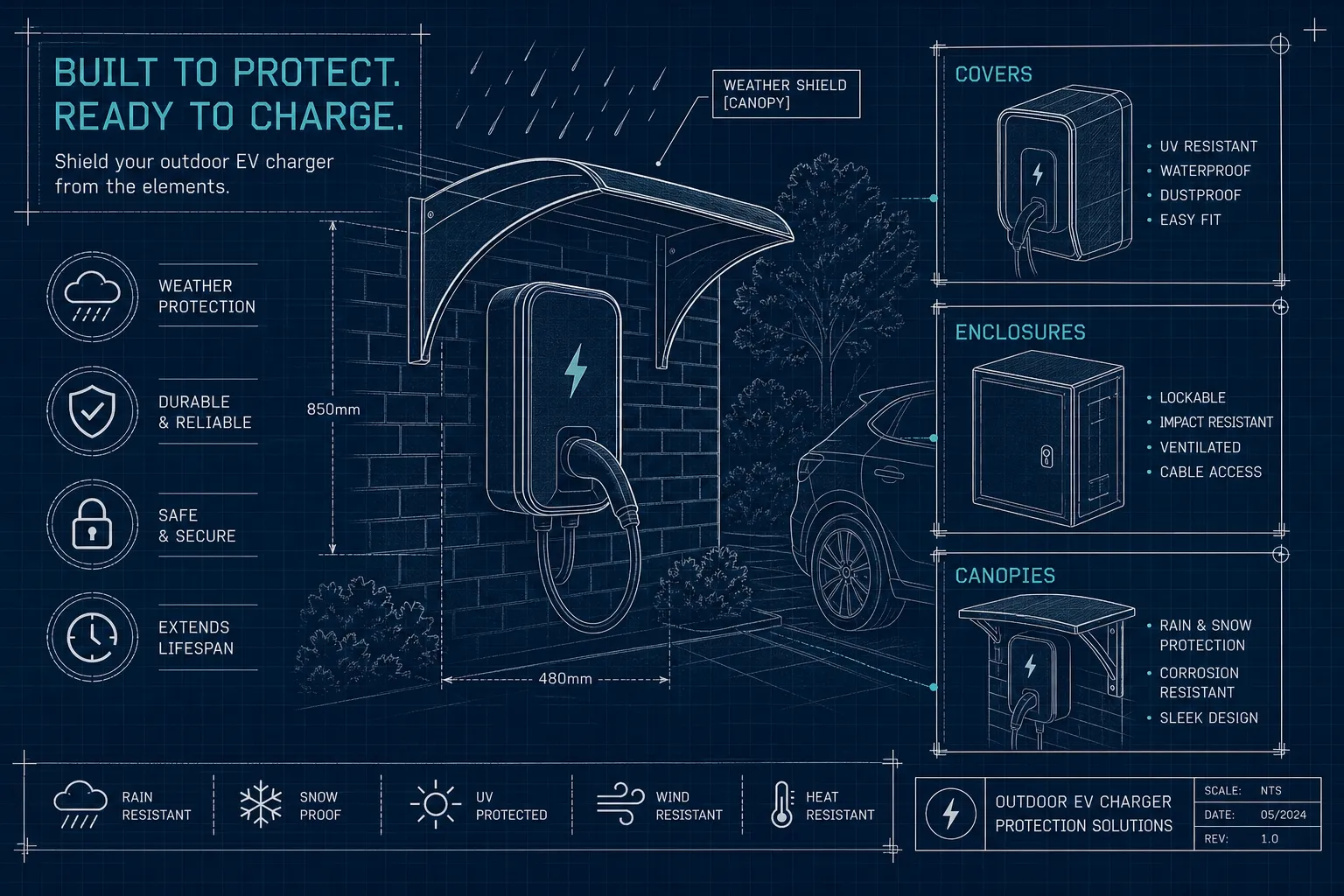
Outdoor EV charger protection starts with a clear-eyed look at what the spec sheet leaves out. Manufacturers rate chargers for outdoor use under baseline conditions, not the compounding, worst-case exposure that real sites deliver day after day. The spec sheet says the hardware can handle rain, dust, and temperature swings, and technically, that's true. What it doesn't account for is five years of Arizona sun baking the housing plastic, three winters of freeze-thaw cycling in the Midwest, or the parking lot at 2 a.m. with nobody watching.
Based on patterns observed across hundreds of outdoor deployments, hardware doesn't fail all at once; it degrades gradually through UV fatigue, moisture intrusion, thermal stress, and opportunistic damage. Operators who catch this early don't retrofit protection after the first replacement cycle. They engineer it into the site from the start, and industry experience consistently shows that decision pays out over the full service life of the installation.
This article gives you a practical framework for doing exactly that. You'll learn the five environmental threats that shorten charger life, how to read IP and NEMA ratings correctly, what each protection tier actually defends against, how to layer in physical security, what code requirements affect your install, and why sourcing these elements separately from different vendors creates problems at scale. Along the way, you'll see how a lockable EV charger enclosure and the right IP rating for your EV charger are just two pieces of a larger site engineering decision.
Why outdoor EV chargers fail faster than expected
Uptime is commonly a primary reliability metric for charging operators. What gets tracked less carefully is the slow physical deterioration that makes uptime problems inevitable years before the hardware technically reaches end of life. EV chargers are commonly rated for 10 to 15 years of service life under normal conditions. Unshaded, harsh-weather outdoor installations routinely trim years off that window.
The five threats shortening your charger's lifespan
UV radiation is the first and most insidious threat. Sustained direct sun degrades the polycarbonate housing, display screens, and cable jacketing on Level 2 and DC fast chargers alike. In hot-arid climates, the combination of UV and ambient heat above 95°F causes chargers to thermally derate, reducing output to protect internal components. That's not a one-time event; it's a recurring performance hit that compounds with each hot season.
Rain and moisture intrusion attack from a different angle. Water that penetrates around cable entry points or seams corrodes terminals, circuit boards, and connector contacts over time. It doesn't require a flood; repeated condensation cycles and minor moisture intrusion do real damage when they go unaddressed across hundreds of charge sessions. Snow and ice add a mechanical dimension, with freeze-thaw expansion cracking housings and forcing seals open on equipment not designed for sustained thermal cycling in sub-zero conditions.
Physical impact and vandalism round out the threat list. Cable cuts are among the most frequently documented forms of vandalism, but vehicle strikes on pedestal-style chargers, forced-entry attempts on locked compartments, and spray-paint damage all contribute to repair costs and unplanned downtime. For commercial networks, a single DC fast charger can lose $500 to $2,000 per day in missed revenue during a downtime event. Across a multi-site network, that revenue loss accumulates quickly into a material budget impact.
Why a charger rated "outdoor" still needs additional protection
An outdoor listing means the charger meets a minimum threshold for installation in an exposed environment. It doesn't mean the charger is optimized for your specific site conditions, and it doesn't mean the OEM's enclosure is sufficient on its own for a 15-year service life under sustained extreme exposure. A Level 2 charger mounted in full direct sun with no overhead shelter is code-compliant. It's also accumulating UV and thermal damage that a canopy or overhead structure would largely prevent.
The NEVI program reinforces this point from a compliance angle: every charging port must maintain greater than 97% uptime averaged over the prior 12 months. Hardware that degrades faster than expected due to unprotected exposure is a structural threat to that requirement, not just a maintenance inconvenience. Treating outdoor EV charger protection as an add-on is accepting a shorter replacement cycle rather than managing it as a site engineering decision.
How to read IP and NEMA ratings before buying anything
IP and NEMA ratings appear on almost every piece of outdoor EV charging hardware and enclosure hardware. They're also frequently misread, misapplied, or treated as interchangeable when they're actually separate classification systems. Getting this wrong means specifying protection that doesn't match your actual site conditions.
IP ratings decoded: what IP54, IP65, and IP67 mean on the ground
The IP (Ingress Protection) rating uses two digits. The first digit rates dust and solid particle protection on a scale of 0 to 6; the second rates water protection on a scale of 0 to 9. A charger rated IP54 has partial dust protection and protection against water splashing from any direction, which is adequate for a covered or lightly exposed install. IP65 means full dust exclusion and protection from low-pressure water jets, which is the right baseline IP rating for an EV charger in a fully exposed outdoor location across most U.S. climates.
For harsher conditions, push the rating higher. IP66 handles powerful water jets and is appropriate for coastal environments, high-washdown sites like fleet yards, or areas with significant precipitation exposure. IP67 adds the ability to withstand temporary immersion, which matters in flood-risk areas or sites where stormwater management isn't ideal. Matching the IP rating to the actual site exposure, rather than the minimum allowable, is what keeps replacement cycles predictable.
NEMA 3R, NEMA 4, and NEMA 4X: picking the right enclosure rating
NEMA ratings are a North American standard that covers similar ground to IP but uses different test criteria and isn't a direct conversion. NEMA 3R provides basic outdoor weather resistance, typically used where general rain exposure is expected. NEMA 4 adds protection from hose-directed water and is the standard for most commercial outdoor charger enclosures. NEMA 4X matches NEMA 4 for water protection but adds corrosion resistance, making it the right call for coastal installations, industrial sites, or anywhere chemical exposure is a concern.
IP and NEMA are approximate equivalents, not identical standards. An enclosure rated NEMA 4 is roughly comparable to IP65 or IP66, but you can't substitute one certification for the other on a specification document. When sourcing enclosure hardware, specify both the NEMA rating and the IP rating to ensure the equipment you receive actually meets the environmental requirements for your site.
Outdoor EV charger protection options: covers, enclosures, and canopies compared
Protection for outdoor EV chargers isn't a single product decision. It's a set of layered choices, and each layer addresses a different subset of the threats described above. Understanding what each tier covers, and what it doesn't, prevents the common mistake of treating one solution as comprehensive when it isn't.
Fabric covers and weatherproof boxes for lighter-use applications
Fabric covers made from Oxford cloth, polyester, or PVC typically run $5 to $30 and handle rain, dust, UV, and light snow. They're appropriate for residential Level 2 installations in lower-risk environments where physical security isn't a primary concern. Most use magnetic closures or hook-and-loop fasteners, which means they provide zero deterrence against tampering. This tier works for homeowners and some light commercial applications, but it's not a solution for unattended public charging or any site with a history of vandalism.
Lockable metal enclosures for security and full element isolation
Steel and stainless steel enclosures with lockable doors run roughly $100 to $150 and above. They address both environmental exposure and unauthorized access by fully enclosing the charger hardware, isolating it from moisture and debris, and deterring opportunistic tampering. When evaluating these, look at the enclosure material and finish (powder-coated steel performs well in most climates; stainless steel is better for corrosive environments), the internal ventilation design, and whether the closure is keyed or padlocked. Each spec affects real-world performance differently.
Ventilation is the most commonly overlooked spec in a lockable enclosure. A sealed box without adequate airflow traps heat, particularly in summer, and can drive internal temperatures high enough to trigger thermal derating or accelerate component aging. A well-designed lockable EV charger enclosure isolates the hardware from external threats while still allowing internally generated heat to escape. If the ventilation design isn't documented in the product spec, that's a red flag.
Canopies and overhead shelters for commercial charging environments
For commercial deployments, a canopy addresses the full overhead environment rather than just the individual charger unit. A properly engineered canopy reduces UV exposure across the entire charging area, deflects rain and snow, manages thermal loading through shading, and integrates lighting. Installed cost for a commercial canopy structure runs roughly $20,000 to $50,000 per stall for most configurations, with higher-spec or solar-integrated systems above that range. That number looks different when you factor in reduced hardware replacement cycles and the performance reliability required to hit NEVI's 97% uptime threshold.
Canopies also do something covers and enclosures can't: they change what the site looks and feels like to a driver. A canopy with integrated lighting, branding panels, and clear wayfinding signals that the operator has invested in the experience. That matters for charging network operators and automotive OEMs who need every location to reflect the brand they've built. At that point, protection becomes site design, and site design becomes a competitive advantage.
Theft and vandalism: the layer most operators underestimate
Physical security is addressed reactively at most charging sites. An operator discovers a cut cable, files a claim, replaces the hardware, and then starts thinking about prevention. Hardware replacement, technician dispatch, and the downtime during the incident are all costs that a well-designed deterrence layer can largely prevent before the first incident occurs.
Physical deterrents: lockable holsters, bollards, and tamper alarms
Lockable cable holsters and charger lock boxes are the first and most affordable layer. They prevent opportunistic cable theft and unauthorized use without requiring significant investment. For pedestal-style chargers exposed to vehicle traffic or high foot traffic, bollards are essential. Typical bollard costs run $250 to $800 per unit, with professional installation adding $500 to $1,500 each. That's not a trivial line item, but it's substantially less expensive than replacing a charger pedestal after a vehicle strike.
Tamper and cable-cut detection alarms add real-time response capability by triggering audible alerts before a thief can complete the action. These work best as part of a managed-site or smart-charger package rather than standalone accessories. The combination of a physical lock box, visible deterrents, and an active alarm covers most opportunistic vandalism scenarios without requiring 24/7 staffing.
Cameras and lighting as the second deterrence layer
Motion-activated cameras and lighting don't physically stop theft, but the deterrence data is compelling. Studies of monitored CCTV in parking environments document roughly a 37% reduction in crime, with an additional 15% when the system is actively watched. The practical setup for most commercial charging sites is a visible camera with clear sightlines to the charger and cable, paired with motion-activated lighting that increases perceived risk after dark.
The goal of this layer isn't to catch criminals after the fact. It's to make the site look like a poor target relative to the effort required. A charger with visible cameras, motion lighting, a physical lock box, and bollards around the pedestal communicates that this particular piece of hardware isn't worth the risk. That message, delivered through the physical environment before any incident, is what keeps replacement and repair costs predictable.
Code requirements that affect your enclosure or shelter install
Permits and inspections are where many outdoor charger installations run into delays, and most of those delays are predictable. Inspectors follow a consistent set of concerns rooted in NEC Article 625 and local amendments. Knowing what they're looking for before you build the site eliminates the back-and-forth that adds weeks to a deployment schedule.
Mounting, GFCI, disconnect, and wet-location wiring basics
NEC Article 625 requires EV equipment to be listed for the environment where it's installed. For outdoor sites, that means at minimum a NEMA 3R enclosure, GFCI protection on the circuit, and a disconnect within sight of the EVSE or a lockable-open disconnect where required. All wiring must use wet-location-rated methods and appropriately rated conductors. Many jurisdictions commonly require chargers to be mounted at least 24 inches above grade to help prevent damage from flooding, snow accumulation, and splashback, confirm this with your local AHJ and the adopted NEC edition in your area. These requirements aren't edge cases; they're the checklist every inspector runs through on every outdoor installation.
How AHJ priorities vary and what that means for your project
The local Authority Having Jurisdiction and the adopted NEC edition determine how these requirements are interpreted and enforced. In coastal or corrosive environments, inspectors commonly require NEMA 4X rather than NEMA 3R. Awnings and canopies that channel runoff toward the charger or junction box create a separate code concern that needs to be addressed in the structural design. Working clearances around the charger, disconnect, and associated panel must be maintained even after the shelter is installed. A canopy that improves weather protection but blocks required service access creates a new compliance problem while solving an environmental one.
A pre-application conversation with the AHJ before the site goes to design saves significantly more time than it takes. Understanding the local interpretation of wet-location requirements, enclosure rating preferences, and any regional amendments to Article 625 shapes the design from the start rather than requiring costly revisions after permit submission.
Why sourcing protection piece by piece costs more over time
The individual product decisions covered above, cover versus enclosure, NEMA 3R versus 4X, bollards and camera placement, all seem manageable at a single site. The problem scales when operators try to apply the same piecemeal sourcing approach across 20, 50, or 100 locations.
The hidden cost of the piecemeal approach
The typical multi-vendor outdoor charger buildout involves a charger from one supplier, an enclosure from another, a canopy from a third, and signage, lighting, and compliance hardware sourced separately. Every vendor handoff introduces lead time variability, compatibility questions, and accountability gaps. When something doesn't fit or a component fails, no single partner owns the problem, and the operator ends up managing the coordination themselves. Across a network, that fragmentation compounds into real schedule overruns and cost variability that wasn't in the original deployment budget.
How Sterling EV engineers protection into the full site environment
Sterling EV's offering is built around a vertically integrated model. Every physical element of the charging environment, canopy, branded enclosure, wraps, toppers, wayfinding signage, compliance hardware, and installation, is designed, manufactured, and delivered by one partner with in-house engineering and nationwide installation crews. The enclosure is engineered to the charger hardware. The canopy is designed for the site's wind and snow load requirements. The signage is developed to align with NEVI and ADA requirements as part of the same coordinated package.
For charging network operators and OEMs deploying at scale, that model means a repeatable process that gets faster and more consistent with every new site added. The sourcing variables are eliminated, the compliance coordination is handled in-house, and accountability for the finished environment sits with one partner rather than being distributed across five. That's the difference between outdoor EV charger protection as a product purchase and protection as a site engineering decision.
Build the protection in, not after
The framework for protecting outdoor EV chargers follows a consistent logic. Environmental threats are real and compounding, the right IP and NEMA ratings set the hardware baseline, and the right structural solution, cover, enclosure, or canopy, addresses the gaps that ratings alone cannot close. Physical security requires its own intentional layer designed before the first incident, and code compliance is non-negotiable regardless of site type or scale.
Operators who run reliable networks long-term treat outdoor EV charger protection as a site engineering decision from day one. They replace hardware less often, hit uptime requirements more consistently, and scale new deployments faster because the protection model is already defined and repeatable. The operators who treat it as a product purchase manage one crisis at a time.
If you're building out a charging network and want a partner who handles the full physical environment from canopy to commissioning, Sterling EV is built for exactly that. Reach out to discuss your site requirements, protection specifications, and what a turnkey approach looks like at your scale.