NEVI Compliance Checklist: Qualify for Federal EV Funding
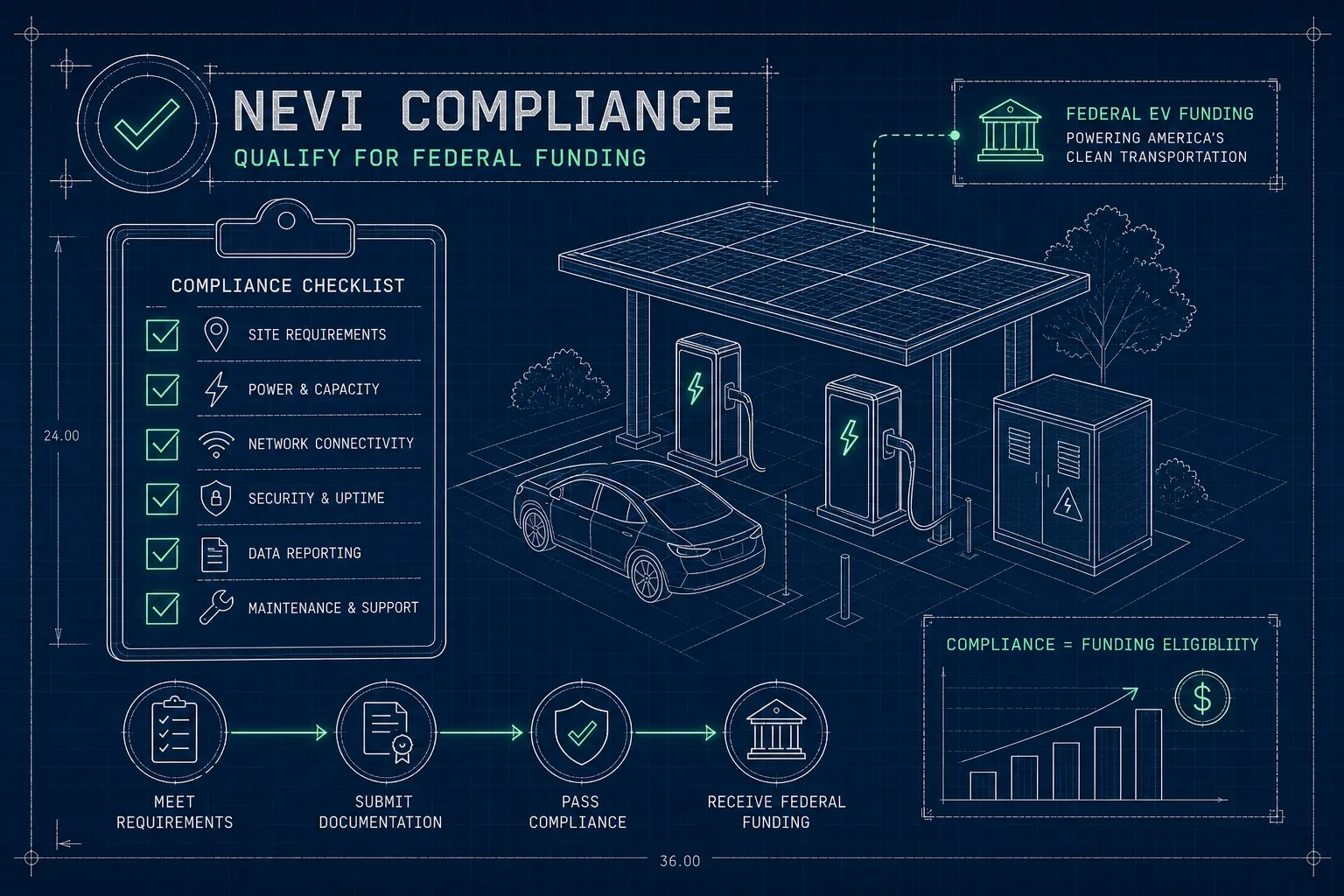
NEVI compliance begins before you select a single piece of hardware. The National Electric Vehicle Infrastructure program allocates $5 billion in federal funding, established under the Bipartisan Infrastructure Law, for EV charging deployment across the United States. A wide range of site hosts are eligible, including fuel retailers, commercial property owners, and fleet operators, but most applications that come back incomplete share the same problem: the applicant discovered a critical requirement after they were already mid-process. A missing data protocol here, a non-compliant connector there, a site that sits just outside the Alternative Fuel Corridor boundary. These are fixable problems, but only if you catch them before you break ground.
At Sterling EV, we work with operators at the physical site level: canopies, signage, enclosures, ADA hardware, and wayfinding. That vantage point puts us in direct contact with where compliance gaps actually show up in the real world, especially on the infrastructure side that separates a federally approvable site from one that fails inspection. This NEVI compliance checklist walks through each requirement domain in the order you need to confirm it, location first, then hardware, then software, then operations, then reporting, then your state-specific documentation package. By the end, you'll know exactly what you have locked down and what needs attention first.
Is your site actually located in NEVI-eligible territory?
Before you evaluate a single piece of hardware, confirm your site qualifies geographically. NEVI Formula Program funds, prior to a state achieving full corridor build-out, must go toward stations located along a federally designated Alternative Fuel Corridor. Verify this against the FHWA AFC map using your site's address. If your site isn't on a designated corridor, nothing downstream matters until you resolve that first.
The benchmark spacing guidance calls for stations roughly every 50 miles along the corridor, with each station placed within one mile of the designated roadway. States can seek exceptions in limited circumstances, but the one-mile proximity rule is the working standard. Confirm your coordinates satisfy both conditions before investing further time in the application.
Public access is non-negotiable for NEVI-funded stations. The station must be available to the public around the clock. A gated fleet depot or a parking structure that closes at 10 p.m. won't satisfy this requirement without a specific program exception. One nuance worth knowing: authorized commercial motor vehicle operators from more than one company count as "public" under the rule, which opens some fleet-adjacent sites that might otherwise seem ineligible.
For operators in states approaching full AFC build-out, the rules shift. Once FHWA certifies that a state's corridors are fully built out, that state can propose alternative public locations outside the AFC network. If your state is in later funding rounds, check its current approved deployment plan to understand whether you're still restricted to AFC-adjacent siting or whether alternative locations are on the table.
NEVI compliance: hardware minimums every funded port must meet
Each NEVI-funded station must include at least four DC fast charging ports, and the station must be capable of delivering up to 150 kW per port simultaneously. That adds up to a minimum aggregate site capacity of 600 kW, not 150 kW shared across four ports. This distinction catches operators off guard more often than almost any other NEVI compliance requirement. The rule is about simultaneous delivery capacity, not peak nameplate rating on a single port.
The federal spec defines a voltage range that covers current and near-term EV models, running from 250 V DC to 920 V DC. Each DC fast charging port must use a CCS Type 1 connector as the federal baseline. NACS/J3400 support is allowed and increasingly referenced in newer state guidance, but it supplements CCS rather than replacing it as the federal minimum. Check your specific state's current solicitation language carefully, this area has evolved, and state specifications may be stricter or more explicit than the federal floor.
Software and interoperability: the protocol stack that matters
Meeting NEVI funding eligibility on the software side means confirming three core communication protocols, and all three need to be verified in writing with your equipment vendor before procurement. OCPP 2.0.1 governs charger-to-network communication. OCPI 2.2.1 governs network-to-network communication, enabling roaming and provider switching. ISO 15118-2 governs charger-to-vehicle communication, which is the technical backbone for Plug and Charge functionality. If the hardware or network management system you're evaluating doesn't support all three, it does not meet NEVI requirements as defined in FHWA technical standards and state procurement guidance.
Network switching capability
Network switching capability is a specific requirement that rules out proprietary lock-in preventing migration between network operators. In plain terms, a site owner must be able to change their backend network provider without replacing the charger hardware. This is a software and configuration capability, not a truck-roll or hardware swap. Per NEVI guidance and 23 CFR 680 provisions, any charger requiring a physical component change to switch networks fails this test. Get this confirmed in writing before signing a procurement agreement.
Payment and pricing transparency
On the payment and pricing side, drivers must be able to pay without an account or app, and the price must be displayed in $/kWh before the session begins. NEVI guidance also addresses payment security practices for card data. These requirements apply at the point of service, not just in marketing materials.
NEVI compliance: uptime requirements and the 5-year maintenance commitment
Each charging port, not each station as a whole, must maintain greater than 97% average annual uptime. The calculation uses a rolling 12-month window, measured monthly. The formula subtracts officially excluded outage minutes from total outage minutes before dividing against the 525,600 minutes in a year. Excluded events include electric utility interruptions, scheduled maintenance, vandalism, natural disasters, and vehicle-related failures. Planned maintenance windows can be removed from the denominator, but per NEVI uptime reporting guidance and applicable 23 CFR 680 provisions, the burden of documenting those exclusions falls on the operator. If state-level contracts apply to your project, documentation requirements may vary, check your state's solicitation language for specifics.
The practical implication of the rolling 12-month calculation: a prolonged outage in your first months of operation will drag your compliance record for a full year. Operators who treat uptime as something to manage reactively typically discover the problem at their first quarterly review, six months after it started. Build maintenance protocols and network monitoring into your operations plan before you go live.
NEVI also requires a mechanism for charging customers to report equipment problems. That mechanism must be multilingual and ADA-compliant. The full compliance window runs for at least five years after the funded equipment is placed in service. NEVI funding creates a multi-year operational obligation with reporting attached. It's not a grant you receive and then set aside.
Reporting obligations you need to plan for before you build
NEVI-covered projects submit quarterly and annual data reports to their state DOT. Quarterly reports must include specific session-level metrics: station and port identifiers, session start and end times, energy dispensed in kWh, peak session power in kW, error codes for unsuccessful sessions, payment method, port uptime for the period, and outage duration in minutes. Annual submittals are broader. This data infrastructure must be operational from day one, not assembled retroactively when your first report is due.
What NEVI monitors, and why your NMS selection matters
Data collection is a core compliance obligation, not an afterthought. The categories NEVI monitors include connector and charging data, energy output, maintenance and installation records, and grid or system upgrade costs. Operators who select their network management system without confirming session-level data export capability often find themselves unable to generate the required quarterly report format. Verify that your charger manufacturer provides the required session-level exports and that your NMS can produce the exact fields your state requires before you finalize equipment selection.
Working through your state's application and documentation process
State EV Infrastructure Deployment Plans are published on the FHWA annual plans page and the Joint Office/Drive Electric state plans repository. Each state submits its plan annually, and FHWA approval is required before the state can obligate funds. Review your state's current approved plan before anything else on the application side. It will tell you what solicitation process is in effect, whether awards are competitive, and what the current funding priorities are. States in later funding rounds often carry stricter criteria than their earlier solicitations did.
The physical site compliance requirements are where infrastructure decisions directly affect your application outcome. ADA-compliant accessible spaces require specific dimensions: at minimum, an 11-foot-wide, 20-foot-long charging space with a 5-foot adjoining access aisle, a 30-inch by 48-inch clear floor space at the charger, and an accessible route connecting to a site entrance. Signage must meet applicable FHWA and state solicitation standards, wayfinding must direct drivers from the road to the station, and safety hardware must be present and documented. Because these requirements touch multiple physical systems at once, a fragmented vendor approach is where compliance risk tends to accumulate. Sterling EV integrates canopies, enclosures, ADA hardware, signage packages, and wayfinding under one accountable partner, which is how we help operators close the gap between what federal requirements specify and what actually gets built in the field.
Beyond the federal technical floor, states layer on their own documentation requirements that vary meaningfully by jurisdiction. California requires EVITP-certified contractor numbers in solicitation responses. Nebraska requires applicants to document compliance with 23 CFR 680 directly. Most states want proof of site control, confirmation of power availability, and a project timeline. These requirements change with each funding round, so treat your state's current solicitation document as the definitive source, not a summary from a prior cycle.
Your NEVI compliance action plan
Work through these six domains in sequence. Confirm AFC corridor eligibility first, nothing else matters if the site doesn't qualify geographically. Then verify hardware specs: port count, simultaneous capacity, and connector requirements. Confirm your full software protocol stack next, making sure OCPP 2.0.1, OCPI 2.2.1, and ISO 15118-2 are all supported and that network switching capability is built into the hardware. Before you go live, verify that your uptime monitoring infrastructure is operational and that your maintenance documentation practices are ready to support exclusion claims. Set up your session-level data collection and reporting pipeline from day one. Then build your state application package using the current solicitation requirements, not a prior-round checklist.
Achieving NEVI compliance isn't a single approval event. It's a sustained operational commitment spanning five years, with quarterly reporting and active uptime management throughout. The operators who move through this NEVI grant compliance checklist cleanly treat the physical site, hardware, software, and documentation as one coordinated build, not a sequence of separate vendor decisions made in isolation. When canopy, signage, enclosures, ADA hardware, and wayfinding are integrated under one accountable source, compliance documentation becomes straightforward and site inspections go clean. That's the standard Sterling EV builds to on every project, and it's the standard your NEVI application needs to reflect from the ground up.