EV Station Setup: A Complete Phase-by-Phase Guide
EV Station Setup: A Complete Phase-by-Phase Guide
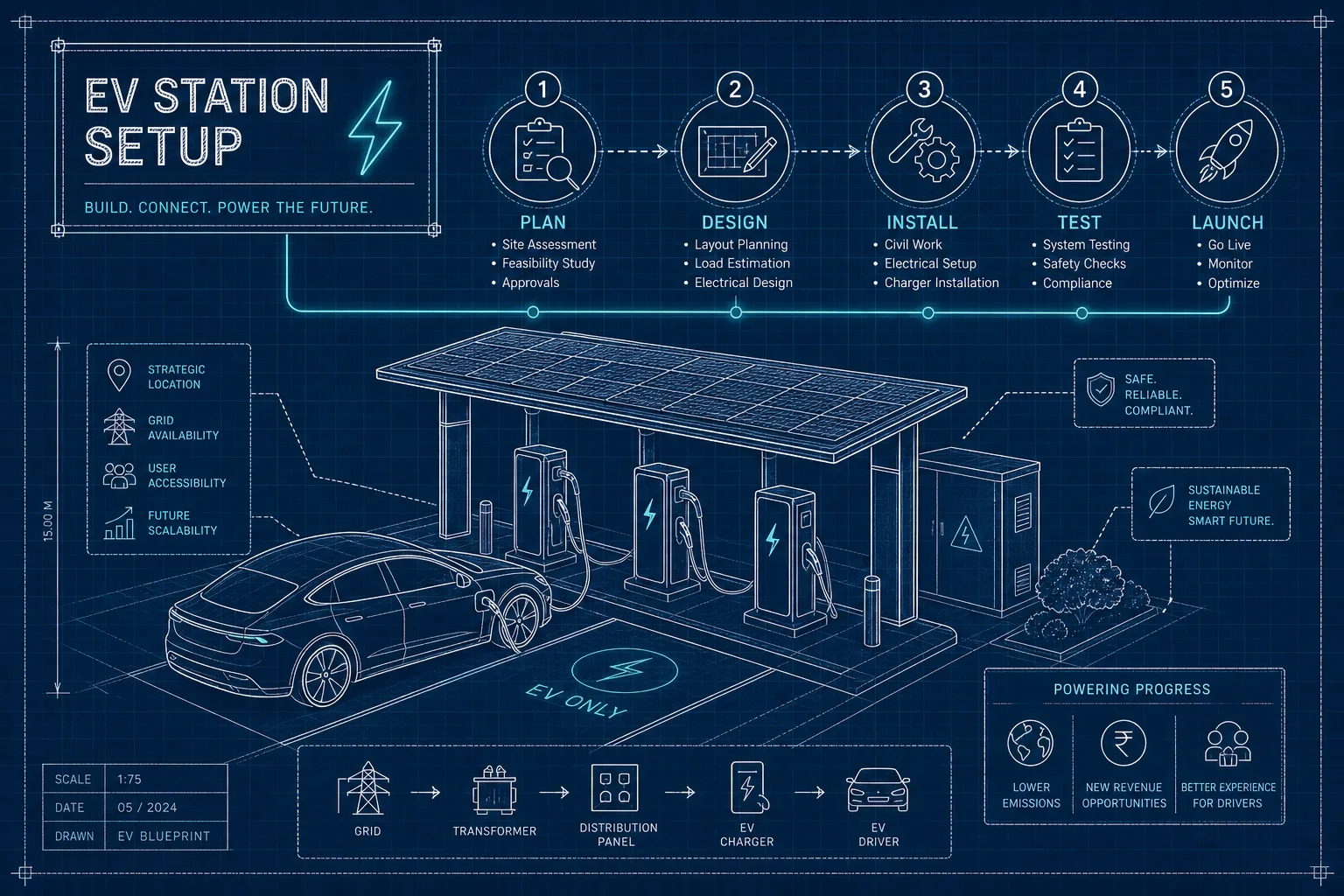
Most operators assume an EV station setup is simple: buy a charger, call an electrician, flip the switch. The reality is a multi-phase process involving site assessment, electrical engineering, permitting, ADA compliance, physical layout, signage, and commissioning. Each phase builds on the one before it, and a misstep in the early stages creates expensive problems downstream. This guide walks through every phase in sequence so you can plan, budget, and execute with confidence. You'll also understand exactly where a single accountable partner can help reduce the coordination burden that typically falls back on the operator.
Whether you're deploying one commercial station or scaling a national network, the fundamentals are the same. What changes is the complexity of managing each moving part simultaneously. Understanding the full sequence before you start is the most effective cost-control decision you can make.
EV Station Setup, Phase 1: Site Survey and Electrical Capacity Assessment
A professional site survey is the foundation of the entire project. A qualified surveyor documents available electrical service, panel location, distance from the power source to proposed charger locations, parking layout, surface conditions, grading, drainage, and any physical obstacles that affect equipment placement. They'll flag utility access points and note infrastructure constraints that aren't visible from a satellite view or floor plan.
Load calculations and service sizing
Load calculations follow the survey. An electrician audits the existing electrical service to determine how much capacity remains after current loads are accounted for. Per NEC 210.19(A)(1) and 210.20(A), circuits and breakers must be sized at 125% of a continuous load's output, meaning a 40A charger requires a 50A breaker. For commercial DC fast charger installations, this isn't a branch-circuit exercise; it requires engineered electrical design and direct utility coordination to confirm the site can handle the added demand.
Panel upgrades for commercial Level 2 sites typically run $2,000 to $10,000, based on AFDC and industry cost data. Full service upgrades for DCFC sites can reach $15,000 to $100,000 or more when transformer work and new switchgear are involved. These ranges vary significantly with local labor rates and utility requirements, so site-specific engineering is essential before finalizing a budget.
The survey output drives every decision that follows: charger type, equipment placement, trenching scope, permit drawings, and total project cost. Operators who skip this step or rush through it often discover mid-project that their electrical service can't support the original plan, a realization that's far more expensive to address at installation than at the survey stage.
Phase 2: Choosing the Right Charger Type and Understanding Real Costs
Level 1 charging uses a standard 120V outlet and requires almost no installation work. It's viable for residential overnight charging but impractical for any commercial or public application. Level 2 operates at 240V and is the standard for workplace charging, retail destinations, and most commercial sites. DC fast charging (Level 3) delivers high-throughput charging and is designed for public corridor use, fleet depots, and high-utilization commercial locations. Matching your use case to the right technology matters: over-building increases upfront cost unnecessarily, while under-building creates a driver experience problem that's difficult to reverse.
Real installed costs by charger type
Installed costs vary widely by site conditions, but typical ranges break down roughly as follows:
- Level 1: $0 to $600 all-in, with little to no electrical upgrade required
- Level 2: $800 to $3,000 for simpler residential or low-complexity installs; commercial sites commonly exceed this range, and electrical upgrades can add $1,000 to $4,000 or more depending on existing service
- DC fast charging: $4,000 to $51,000 depending on site infrastructure and utility coordination needs
Site electrical work and infrastructure are where costs vary most, and where budget surprises tend to surface when a project hasn't been properly surveyed upfront. The charger hardware itself is often the smaller line item once you account for trenching, conduit, panel upgrades, and utility coordination. This is why a rigorous EV station setup process starts with the electrical assessment, not the equipment catalog.
Before ordering equipment, confirm amperage rating, connector type (J1772 vs. NACS), networking capability, weatherproofing ratings, and how service access works. For NEVI-funded sites and most public commercial installations, network connectivity, payment processing, and uptime monitoring are required features, confirm compliance obligations before specifying hardware, since retrofitting these capabilities after installation adds cost and timeline.
Phase 3: Permits, ADA Requirements, and Signage Rules
Commercial EV charging projects typically require an electrical permit, a building permit for any structural work, and utility coordination for service upgrades. DC fast charger projects often trigger full plan review because of the higher electrical loads and site-specific scope. Permit requirements vary by jurisdiction, and pulling the wrong permits, or skipping them entirely, creates costly stop-work situations that stall entire timelines.
ADA compliance requirements
ADA compliance applies to any public or commercial charging installation. The U.S. Access Board's EV charging accessibility guidance calls for a vehicle charging space at least 11 feet wide and 20 feet long, with a 5-foot access aisle running the full length of the space. The surface must be firm, stable, and connected to an accessible route to the facility entrance. Bollards, wheel stops, and curbs cannot obstruct that route. NEVI-funded sites carry additional ADA documentation requirements tied to compliance reporting, operators should review applicable state solicitation requirements and NEVI program guidance to understand what site-level checklists and records are required.
Permits: local vs. utility, and signage compliance
Signage serves two purposes: compliance and user experience. Drivers need to find the station from the road, locate the correct stall, and understand pricing and availability before they park. Required elements typically include reserved EV space stall markings, directional wayfinding from the site entry, and NEVI program signage standards for federally funded installations. NEVI right-of-way signs must comply with the MUTCD, while on-premises signs fall under 23 CFR Part 750. Getting signage right at the planning stage is far easier than retrofitting it after the site opens.
Phase 4: Physical Site Layout, Parking, Protection, and Overhead Infrastructure
Bay orientation, stall width, vehicle entry and exit paths, and queuing room for high-utilization sites all need to be resolved before equipment arrives on site. Impact protection matters here too: bollards and wheel stops protect chargers from vehicle damage but must be positioned so they don't block accessible routes. Surface grading and drainage factor into the layout plan, particularly for sites in regions with significant precipitation or freeze-thaw cycles.
Outdoor charging equipment faces year-round exposure to UV, rain, snow, and temperature swings. Overhead canopy structures can extend equipment service life, provide integrated lighting, and offer branding surface area, at 24/7 unattended public sites in particular, canopies commonly improve uptime and reduce long-term maintenance costs, though they are not universally required by code or NEVI. Equipment enclosures protect charging hardware while maintaining required ventilation and service access.
The visual identity of a charging site is a design decision, not an afterthought. Above-stall toppers add visibility and driver information. Equipment wraps brand generic charger hardware while maintaining OEM-required ventilation clearances. Wayfinding panels direct drivers from the site entrance to the right stall. All of these elements need to be specified and coordinated before installation day, integrating them after the fact means mobilizing a crew again, which adds cost and extends the timeline.
Sterling EV handles these physical elements, canopy engineering and fabrication, equipment wraps, toppers, wayfinding, and ADA hardware, through a single project workflow. That means one specification process, one lead time, and one set of installation drawings instead of four separate vendor conversations happening in parallel.
EV Station Setup, Phase 5: Installation Sequence and Final Commissioning
A commercial EV charging installation runs in a defined sequence: site prep and trenching, conduit and electrical rough-in, equipment mounting, canopy or overhead structure assembly, signage and enclosure installation, and final electrical connections. Larger sites may involve multiple crews working across these phases simultaneously. Sequence dependencies matter: electrical rough-in must happen before a concrete pour. Missing that dependency doesn't just delay one task, it delays every task that follows.
Commissioning: what gets tested
Commissioning is the structured verification process that confirms every system works as specified before the site opens to drivers. A complete commissioning checklist covers power delivery, connector function, network connectivity, payment processing, station ID configuration, and safety checks. A site that skips or rushes commissioning typically opens with unreported faults, poor driver experience, avoidable service calls, and potential compliance exposure. For NEVI-funded sites, commissioning documentation is a compliance requirement per program guidance, not optional paperwork.
Federal incentives and tax credits
Federal incentives can meaningfully reduce total project cost. The Alternative Fuel Vehicle Refueling Property Credit (30C) offers 6% for commercial installations, rising to 30% if prevailing wage and apprenticeship requirements are met, capped at $100,000 per unit for commercial property, different limits apply to residential installations. The NEVI Formula Program and DOE Charging and Fueling Infrastructure grant programs provide additional funding for public and corridor charging. Confirm current eligibility dates, location requirements, and wage compliance rules with a qualified tax advisor before relying on any incentive estimate, since program terms changed under the IRA and subsequent Treasury guidance.
Why Managing One Vendor Beats Coordinating Five
When operators split the work across an electrical contractor, a canopy fabricator, a signage vendor, a charger supplier, and a separate installation crew, they also inherit the coordination gaps between all of them. Lead time mismatches, spec conflicts, and permit delays caused by missing drawings are common outcomes of that model. Each vendor is accountable only for their piece, not the finished site. When something doesn't fit or a schedule slips, the coordination problem lands back on you.
Sterling EV brings engineering, fabrication, powder coating, assembly, logistics, and nationwide installation under one roof. Every physical element around the charger, canopy, enclosure, wrap, topper, signage, wayfinding, ADA hardware, and commissioning support, is handled through one point of contact, one project timeline, and one accountable partner. That vertical integration means spec conflicts don't arise between vendors because there are no separate vendors to misalign.
For operators building at scale, that consistency builds a real operational advantage. Every new site Sterling EV deploys adds to a repeatable model with documented processes, pre-engineered details, and installation crews who already know the system. From a single pilot location to a fifty-site rollout, the fundamentals hold, and each successive site benefits from the efficiency of the one before it.
Plan the Full EV Station Setup Before the First Shovel Moves
A well-planned EV station setup moves through each phase cleanly: site survey informs electrical design, electrical design determines equipment selection, equipment selection shapes the physical layout, and commissioning confirms everything works before drivers arrive. Skipping or compressing any phase creates downstream problems that cost more to fix than they would have to prevent.
From a single location to a multi-site network, the process is the same. What varies is how much coordination complexity you take on, and whether you're managing it through one accountable partner or across five separate vendors. If you want to move faster, finish cleaner, and build a repeatable deployment model, Sterling EV is built for exactly that. Reach out to get a site survey on the calendar and start your EV charging station installation the right way.