EV charging shade structures: canopy vs. solar carport guide
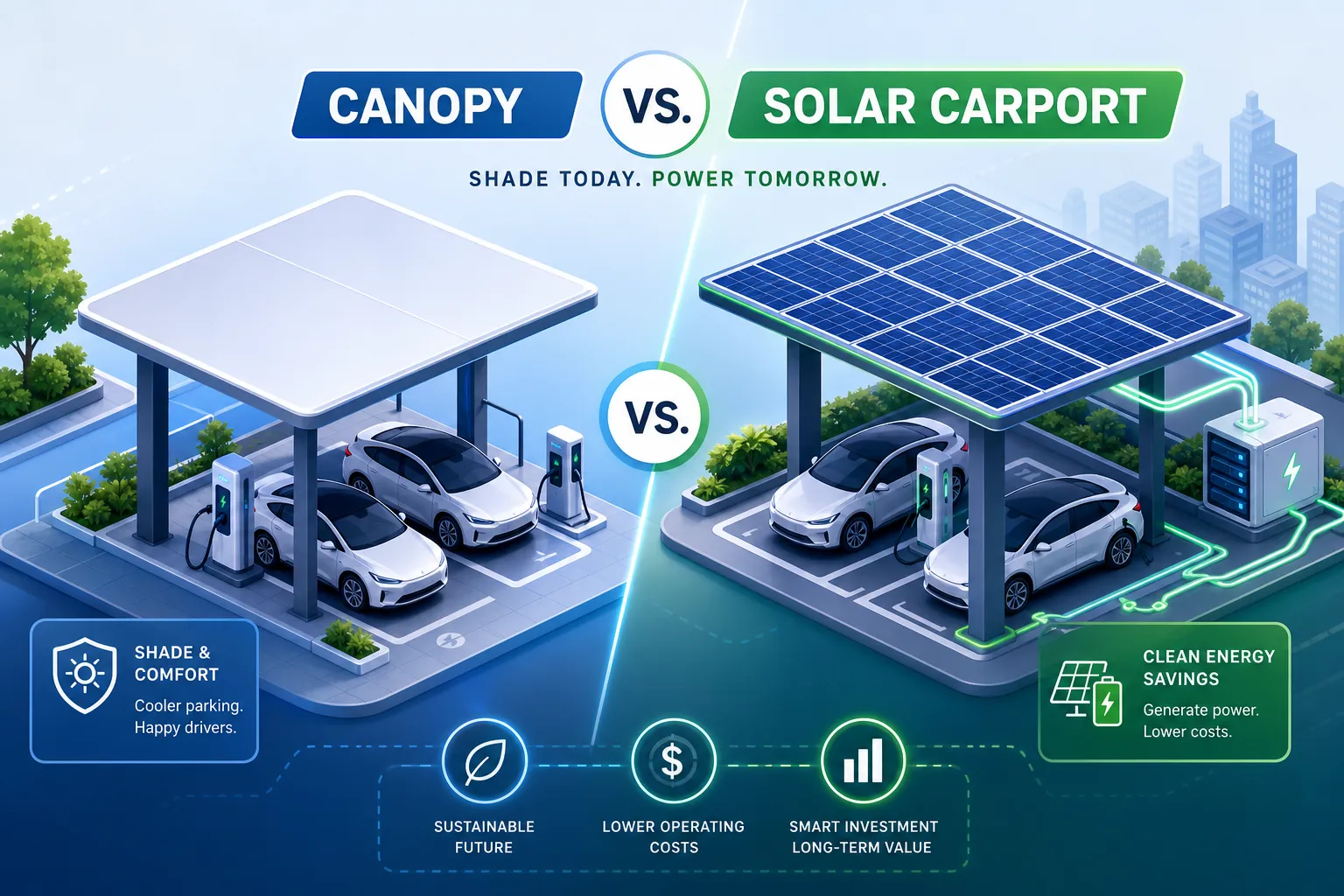
An EV charging shade structure is the difference between hardware that weathers prematurely and a site that actually works for drivers. Exposed stalls push people away in extreme heat, heavy rain, and direct sun, and unprotected equipment degrades faster than spec sheets suggest. A well-chosen overhead structure solves both problems at once: it protects the hardware, keeps drivers comfortable during dwell time, and signals that this site was designed rather than dropped in a parking lot as an afterthought.
Three structure categories dominate the market. The full overhead canopy, the solar carport, and the lighter tensile sail shelter each serve a different site profile, budget ceiling, and energy goal. Understanding the differences before you talk to vendors saves real money and avoids permitting surprises. When all the physical elements around the charger, overhead structure, integrated lighting, branding, signage, and compliance hardware, come from one accountable partner like Sterling EV, a site goes from a charger installation to a finished charging environment. Here's how to choose the right foundation for that environment.
Three types of EV charging shade structures and when each makes sense
Canopy: the full overhead charging environment
A purpose-built EV charging canopy is a roofed overhead structure engineered specifically for charging bays. It spans one or multiple stalls, handles integrated lighting and branding panels as native features, and can accept solar PV as an add-on or design-in option. This format earns its cost on premium retail sites, high-traffic public charging corridors, and any deployment where visual identity across a network matters. Structural forms range from single-bay to multi-bay to cantilever configurations, and the right choice depends on lot dimensions and column placement constraints.
Solar carport: shade plus on-site power generation
The solar carport is a shade canopy with PV modules built into the roof surface. The electricity those panels generate can offset grid draw during peak charging hours, reduce demand charges, and in net-metering markets, credit the site owner for excess production. The trade-off is significant: higher upfront cost and more engineering complexity in exchange for long-term energy savings and federal incentive eligibility. This format fits best on larger lots, fleet depots, and sites in strong net-metering states where the energy economics actually close.
Tensile sails and shelter structures: the lightweight option
Tensile membrane and shade sail structures are the lowest-cost, fastest-to-deploy category. They provide basic UV and light rain protection for smaller sites where full coverage isn't the goal. The limitations are just as concrete: no solar integration, a lighter visual footprint, and less suitability for large-scale or premium deployments. For a standalone convenience store adding two Level 2 stalls, a tensile structure may be the right call. For a network operator building 40 locations, it isn't.
Materials and durability: what actually holds up in the field
Frame materials: steel vs. aluminum
Steel offers higher structural strength and better support for solar panel loads or large multi-bay spans, but it requires powder coating or galvanization to resist corrosion over time. Aluminum is lighter and naturally corrosion-resistant, making it the preferred frame material for moderate-span canopies in coastal or high-humidity markets. Either material, when properly finished and engineered, can carry a structural design life of 20 years or more, though actual design life and warranty terms vary by vendor and protective finish. Finish quality and connection detailing matter as much as the base material selection.
Roofing surfaces and UV protection for your EV charging shade structure
Three roofing surfaces dominate commercial EV canopy projects. Polycarbonate panels are lightweight, diffuse light evenly, and block UV effectively. Metal standing seam is the most durable option and integrates cleanest with solar PV systems. Tensile membrane, typically HDPE or PVC fabric, is rated for UV blocking and light diffusion at lower structural weight. UV protection at the structure level helps preserve charger components, particularly cable jackets, display screens, and payment terminals, while measurably improving driver comfort during warm-weather dwell time. Manufacturers recommend shading as a standard practice for extending service intervals on outdoor EVSE hardware.
Solar carport sizing: matching energy output to actual charging load
Estimating what a solar carport can realistically generate
In moderate U.S. markets, a commercial solar carport produces roughly 1,000 to 1,200 kWh per kWp per year. In the Sun Belt, generation can reach 1,700 kWh per kWp annually or higher, while cloudier northern markets typically land closer to 900 to 1,200 kWh per kWp. A practical sizing framework: divide your expected annual charging energy consumption in kWh by the local annual yield per kWp to get the approximate array size you need. For a 10-port Level 2 site drawing roughly 7.2 kW per active port, and assuming moderate daily utilization of four to six hours per port, that calculation typically points to an array in the 30 to 60 kWp range depending on local solar resource. Confirm utilization assumptions with your engineer before finalizing the array size.
When solar integration is worth the added complexity
Solar carports make financial sense under a specific set of conditions: net metering is available in the state, the lot is large enough to justify the array size, federal ITC eligibility is intact for the project timeline, and utility interconnection won't delay the whole buildout. For 2026 commercial projects, the Section 48/48E solar ITC provides a 30% base credit on the solar carport structure and PV system, while Section 30C covers qualifying charger hardware and installation costs up to $100,000 per port. Both incentives have mid-2026 placed-in-service cutoffs, so timeline planning is not optional. Where those conditions don't align, a shade-only canopy is the smarter procurement decision.
EV charging shade structure cost per stall, permitting, and electrical requirements
What actually drives per-stall cost
Installed costs for a pure charging station shade canopy run roughly $20,000 to $50,000 per stall based on current 2026 market data. Solar carport installations add the PV system and heavier structural requirements, pushing that range to approximately $35,000 to $90,000 per stall depending on array size and site conditions. The solar structure itself runs about $4 to $7 per watt installed in the U.S., covering structural steel, racking, and installation, before charger costs are factored in. The biggest swing factors are foundation design and electrical distance. Cantilever foundations carry a 20 to 35% structural premium over T-frame designs. The distance from the service panel to the charging area, ground conditions, and whether utility service upgrades are required can move the total project number by tens of thousands of dollars on a single site.
Permitting, NEC compliance, and ADA requirements
Every permanent EV canopy in a commercial parking lot triggers both a building/structural permit and an electrical permit. The structural submittal needs stamped engineering drawings showing wind, seismic, and snow load compliance under IBC Chapter 16 and ASCE 7. The electrical submittal covers NEC Article 625, which governs EVSE branch circuits. Three requirements apply: each outlet above 16 amperes or 120 volts requires an individual branch circuit; overcurrent protection must be sized at 125% of the maximum EVSE load for continuous duty; and GFCI protection is required for all EV charging receptacles. ADA requirements apply to stall geometry, accessible path-of-travel, and signage. Solar carport projects require a combined structural and PV electrical permit set, which adds review time to the schedule. Plan for rapid shutdown compliance and grounding/bonding requirements specific to the solar array as separate deliverables from the EVSE permit.
Why a single turnkey partner changes what the finished site looks like
The cost of assembling the installation piece by piece
When a property owner sources a canopy with EV charger integration from one vendor, an electrician from another, a signage fabricator from a third, and a branding shop from a fourth, coordination gaps are not a risk; they are a certainty. Misaligned mounting heights, incompatible conduit routing, and signage that doesn't account for canopy column placement all show up on commissioning day. The result is a site that looks assembled rather than designed, and the rework costs land on whoever owns the project.
How Sterling EV builds it as one cohesive environment
Sterling EV's vertically integrated model covers custom-engineered canopies, equipment wraps, branded panels, integrated lighting, NEVI-compliant signage, ADA wayfinding, and compliance hardware, all designed together and installed by their own nationwide crews. Engineering, fabrication, powder coating, and logistics happen under one roof, so every element fits the site plan from day one rather than getting reconciled in the field. For operators building at scale, that produces a repeatable deployment model: each new location gets faster and more consistent because the process is already proven, not rebuilt from scratch with a new vendor mix.
Vendor checklist before you request quotes
Before any proposal conversation, confirm these six points with every parking shade structure for EVs or solar carport vendor you evaluate. The answers separate vendors who supply a structure from partners who deliver a finished site:
- Structural warranty term and coverage scope: does it cover the steel frame, the membrane or roofing surface, or both, and for how long?
- Engineering and stamped drawings: are these included in the bid price, or quoted separately as a line item that inflates the actual cost?
- Lead time from signed contract to on-site completion: get a committed date range, not a ballpark, and confirm who owns schedule risk if fabrication or permitting runs long.
- In-house vs. outsourced installation crews: outsourced installation adds a coordination layer that affects accountability, quality, and schedule.
- Compliance scope: who handles ADA stall layout documentation, NEVI signage, and permit applications, and is that service included or billed separately?
- Branding and finish customization: confirm RAL powder coat options, panel graphics capability, and lighting integration before the design process starts, not after.
This checklist matters more at scale. A single coordination gap on one site is a problem. That same gap multiplied across 20 or 40 locations in a network becomes a systemic failure that costs time, budget, and brand consistency.
Matching the right EV charging shade structure to the right site
The core decision comes down to three variables: site profile, energy economics, and future growth. Canopies belong on premium retail and public charging sites where visual identity and weather protection justify the investment. Solar carports belong where energy economics close, net metering is available, and the lot is large enough to support a meaningful array. Tensile shelters belong on simple, small-footprint sites where basic coverage is the only requirement. Adding one bridging question helps frame the choice: how much does this site need to grow in the next five years, and does the structure you're buying today leave room for that?
Size electrical infrastructure for where the site will be in five years, not where it is today. Panel capacity, conduit sizing, and raceway space are far cheaper to add during initial construction than to retrofit around an installed canopy. Permitting timelines for solar-integrated structures run longer than most operators expect, so build that reality into your project schedule before you commit to a go-live date.
The physical environment around the charger is what drivers actually experience, and what keeps hardware in spec for the long term. Choosing the right EV charging shade structure is the difference between a professional site and a charger bolted to a parking lot pole. A well-engineered solar canopy for chargers or a purpose-built charging station shade canopy with integrated lighting, compliant signage, and consistent branding isn't a premium add-on; it's the baseline for any site built to last. If you're building more than one location, work with a partner who controls the full process from the engineering table to the commissioning punch list. That's how networks scale without the variance. Sterling EV is built to do exactly that.