EV Charger Enclosure vs Open Mount: How to Choose
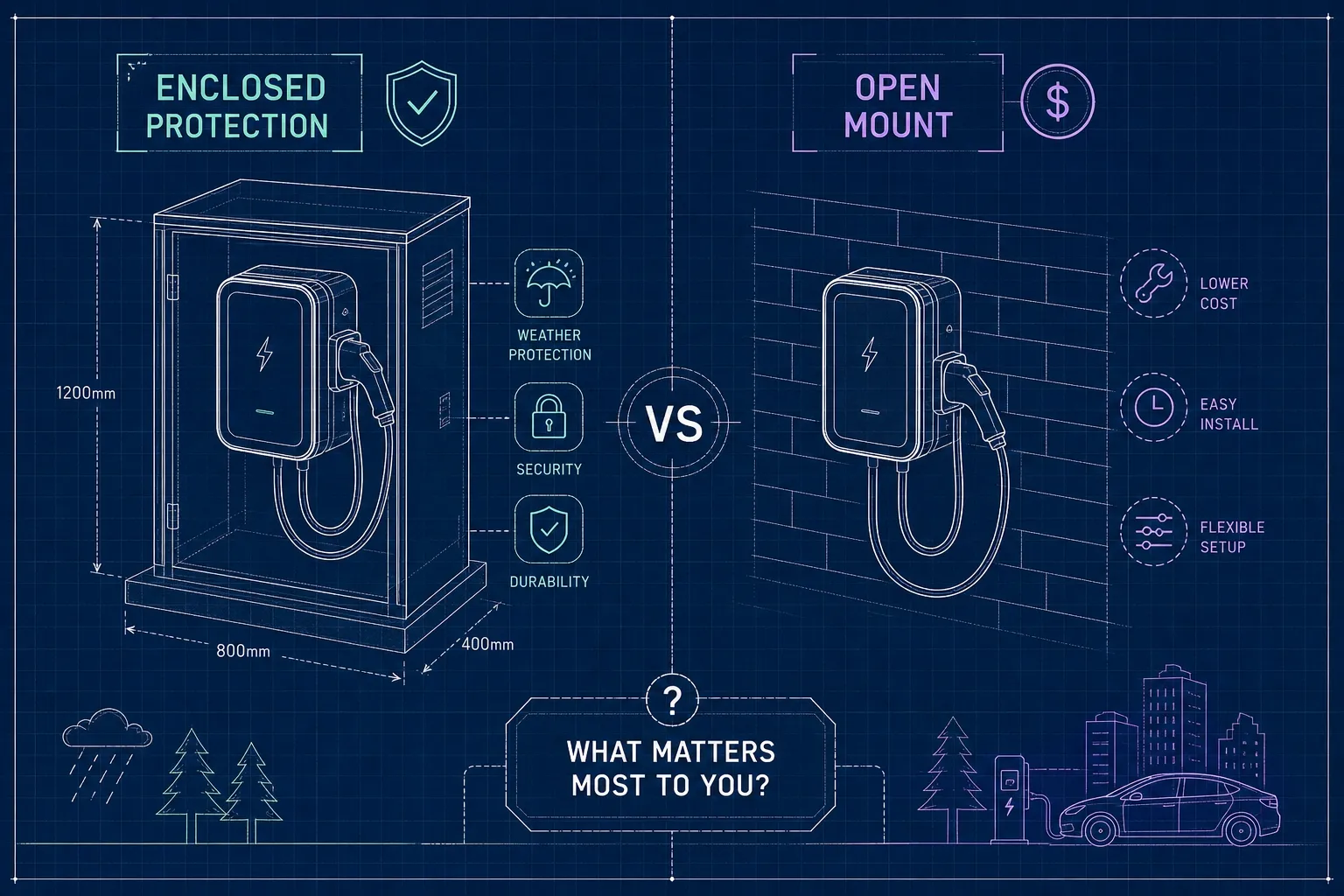
When weighing an EV charger enclosure vs open installation, most homeowners focus almost entirely on the unit itself, the brand, the amperage, the app, and spend little time thinking about how it gets mounted or protected. That gap has real consequences. Installation approach affects how long the hardware lasts, whether it clears inspection, and how much you'll spend correcting a setup that wasn't right for the site in the first place.
The core tension is straightforward: open installations are simpler and cheaper upfront, but enclosed setups earn their cost through durability, code compliance, and long-term performance. Neither choice is universally right. The correct answer depends on your site's actual exposure, local code requirements, and how the charger will be used over the next decade.
This guide covers NEMA ratings, NEC requirements, thermal trade-offs, real cost ranges, and a practical decision checklist you can use before your installer shows up, drawn from experience designing and manufacturing protective enclosures for EV charging deployments ranging from single-stall residential setups to multi-site commercial networks.
Open vs. Enclosed: What Each Setup Actually Involves
An open installation means the charger mounts directly to a wall, post, or pedestal with no additional housing surrounding it. The charger's own built-in weather rating is the only layer of protection between the hardware and the environment. This approach is common in covered garages, carports with solid overhead protection, and locations where ambient exposure stays consistently low. "Open" doesn't mean unprotected; it means the charger's integral housing is doing all the work.
An enclosed installation adds a separate outer box, cabinet, or enclosure around the charger or its wiring connections. These range from basic weatherproof junction boxes that protect connection points to full ventilated cabinets housing the entire EVSE unit. There's an important distinction here: enclosing the charger unit itself is a different scope than enclosing only the wiring compartment or disconnect, and the two serve different protective purposes.
Most modern Level 2 chargers ship with integrated weatherproof housings designed for direct outdoor mounting. The real decision isn't simply "box or no box", it's whether the charger's native rating matches what your installation environment actually demands. Does your site require more protection than the charger's own housing already provides? That's the question worth answering before you commit to a mounting approach.
EV Charger Enclosure vs Open Installation: When NEMA Ratings and NEC Code Decide for You
One of the most common points of confusion in EV charger installations is conflating NEMA outlet types with NEMA enclosure ratings. NEMA 14-50 and 6-50 describe plug and receptacle formats. NEMA 3R, 4, and 4X describe how well a housing resists environmental conditions. These are completely separate classification systems, and mixing them up leads to real specification errors.
NEMA 3R protects against rain, sleet, and snow, making it adequate for standard outdoor wall mounts with overhead shelter. NEMA 4 adds protection against windblown rain, splashing water, and hose-directed water, a meaningfully higher bar for fully exposed outdoor EV charger installations. NEMA 4X layers corrosion resistance on top of all NEMA 4 protection, which makes it the right call for coastal environments, road-salt zones, and any site near a car wash or high-pressure cleaning operation. The practical rule: match the enclosure rating to the worst condition the site regularly sees, not the average.
Per NEC Article 625, the code doesn't mandate a separate enclosure simply because the equipment charges an EV. For outdoor receptacle-based installs, the code requires weatherproof in-use covers and GFCI protection for wet locations. For hardwired EVSE indoors, NEC Article 625 focuses on branch circuit sizing, disconnecting means, grounding, and equipment listing. The weatherproof protection requirement is triggered by location and equipment type, not by the charging function itself.
Local code is where the baseline often tightens. Some jurisdictions adopt amendments requiring listed cabinets, listed raceways, or additional fire protection beyond the NEC baseline, and a permit submission frequently surfaces those requirements before the hardware goes on the wall. Check with your Authority Having Jurisdiction before assuming NEC baseline is sufficient for your municipality. That conversation before the design is finalized is worth far more than a failed inspection after the hardware is already mounted.
Weather Protection, Corrosion, and Long-Term Durability
A standard outdoor wall mount in a temperate climate with solid overhead shelter generally does fine with a NEMA 3R-rated charger or enclosure. A fully exposed driveway pedestal in a coastal environment is a different problem entirely. Salt air and direct precipitation compromise standard finishes and seals over time, and the degradation is gradual enough that you won't notice it until the charger stops working reliably. NEMA 4X weatherproof EV charger housing exists precisely for these conditions.
Freezing environments introduce a specific risk that's easy to overlook: moisture accumulation inside any enclosure that then freezes during a cold snap. Proper drainage provisions, pressure equalization vents, and sealed conduit entry points prevent ice buildup from forming inside the box and damaging components. Open installations avoid sealed moisture trapping, but they expose electronics directly to frost and wind-driven precipitation, meaning freezing protection has to come from mounting location and environmental shielding rather than any housing.
Impact protection is an argument that often resolves the enclosure debate for commercial and fleet applications. An enclosure provides a physical barrier against landscaping equipment, vehicle proximity, vandalism, and incidental contact. Open installations rely entirely on mounting height, site layout, and bollards for physical protection. For chargers in parking lots, public-access locations, or high-traffic commercial sites, the impact argument alone often tips the decision toward an enclosure, particularly where uptime expectations are high.
Not all enclosures solve this equally well. A generic NEMA 4X cabinet that traps heat or blocks service access trades one problem for another. The meaningful distinction is between a repurposed electrical cabinet and an enclosure designed specifically for EV charging hardware, one where the ventilation path, thermal clearances, and service access panels are engineered around the charger's actual footprint and heat output. Sterling EV builds enclosures to that standard, with powder-coated corrosion-resistant finishes, OEM-compliant ventilation clearances, and properly positioned access panels designed for EV charging deployments specifically.
Thermal Management and Maintenance Access: The Overlooked Trade-Offs
Level 2 chargers generate meaningful heat during sustained charging sessions. In an unventilated or undersized enclosure, that heat accumulates and can trigger thermal throttling, reduced charging speed, or premature component wear. Several enclosure manufacturers explicitly advertise ventilated designs to address overheating, and that reflects a genuine engineering constraint, not just marketing language. A second housing around a charger that already has a sealed design can trap heat with no protective benefit if the box doesn't provide a proper airflow path.
Ventilation Best Practices
The standard approach for enclosure ventilation is low intake and high exhaust, using the chimney effect to move warm air out naturally. Filtered intakes prevent dust and debris from accumulating on internal components. Any ventilation cutout added to an enclosure needs to preserve the enclosure's NEMA or IP rating using sealed gaskets and manufacturer-approved vent hardware, not open holes that compromise the protection level you specified.
Filter Maintenance
Filters require regular maintenance. A clogged intake filter defeats the ventilation design entirely, allowing heat to build even in an otherwise well-specified enclosure. Build filter inspection into any maintenance schedule for enclosed outdoor installations, and confirm the enclosure design provides accessible filter replacement without requiring tools or partial disassembly.
Service access is worth more attention than most installation decisions give it. An open installation is easy to inspect, clean, and service because every component is visible and reachable. A poorly designed enclosure can make routine maintenance significantly harder: front-only access panels that require tools to remove, doors that swing into tight spaces, or wiring routed across the charger's own service port. Good enclosure design preserves clear access to the charger's display, reset button, cable management, and wiring compartment without requiring partial disassembly to reach any of them.
Costs: EV Charger Enclosure vs Open Installation
A weatherproof outdoor enclosure for a Level 2 charger adds roughly $200 to $800 to a straightforward wall-mount install. Materials typically run $100 to $300 for a weatherproof enclosure or outdoor-rated box plus mounting hardware. Labor adds $100 to $500 depending on how much conduit routing, weatherproof sealing, and outdoor wiring work the installation requires. For a full outdoor setup versus a covered indoor install, the total cost difference commonly lands between $500 and $1,000.
The installation type shifts that range considerably:
- Exterior wall mount near the panel, minimal conduit run: sits near the low end, the enclosure itself is the main added expense, often $200 to $400 total.
- Pedestal or driveway installation: pushes to $400 to $800 or more, because the stand, concrete work, trenching, and longer conduit runs add up regardless of the enclosure choice. At this scope, civil and electrical work typically drive the budget, not the enclosure.
Warranty and insurance factors are worth addressing before the install date. Most major manufacturers don't expressly endorse specific third-party enclosures as warranty-safe; warranty protection generally depends on installing within the manufacturer's published installation instructions. Aftermarket enclosures that cause overheating, moisture intrusion from improper sealing, or physical damage from poor mounting can create warranty gray areas, so keeping installation records and enclosure specifications on file is worth the few minutes it takes. Some homeowner and commercial property insurance policies credit properly rated enclosed installations for reduced exposure, a call to your broker before the install date can confirm whether that applies and what documentation (NEMA rating, installation records) they'd want to see.
How to Decide: A Practical Checklist for Your Site
Open installation is the right call when the charger sits inside a conditioned or covered garage with no direct weather exposure and the charger's native NEMA or IP rating matches the environment. It also makes sense in low-traffic locations where physical impact is unlikely, and where budget is the primary constraint and the site conditions genuinely don't require added protection.
An enclosure earns its cost in a few clear situations. If the installation is fully outdoors with no overhead shelter, NEMA 4 is the minimum, NEMA 4X for coastal or road-salt environments. If local code or AHJ requirements specify listed enclosures for the equipment location, that decision is already made for you. Regular public or vehicle traffic near the mounting location, or charger use at a commercial, fleet, or multi-unit property where uptime and OEM compliance aren't optional, these also point clearly toward enclosure.
Before specifying the mount type, answer three questions about your site. What's the worst weather condition this location regularly sees? Who has physical access to the charger? Does the charger's own rating cover that exposure, or does it fall short? Those answers, matched against the checklist above, resolve most decisions without a full engineering review, and they're far better answered before the hardware is ordered than after it's already on the wall.
The Right Setup Is the One That Matches the Actual Site
Choosing between an EV charger enclosure vs open installation isn't a style preference. It's a function of your site's real exposure, applicable code, and how long you expect the hardware to perform reliably. The NEMA rating framework and NEC Article 625 give you a defensible starting point; local code and the manufacturer's installation instructions fill in the specifics.
Thermal management and service access deserve as much attention as weather protection. A well-designed enclosure handles both without compromise. A poorly selected one creates new problems while solving the original one. The difference comes down to whether the enclosure was designed for EV charging hardware or adapted from a generic electrical cabinet.
For commercial charging sites where durability, ventilation compliance, and a finished appearance all need to work together, purpose-built EV enclosures are the practical answer. Sterling EV's manufacturing process is built around exactly that combination. Use the checklist above to evaluate your specific location before your install date, getting this right upfront is the most reliable way to avoid a costly change order and reach a setup that performs as expected well past commissioning.
Frequently Asked Questions
Do I need NEMA 4X for a coastal home?
In most cases, yes. Salt air accelerates corrosion on standard finishes and seals in ways that aren't immediately visible. NEMA 4X adds corrosion resistance on top of NEMA 4's weather protection, making it the appropriate rating for coastal installations, road-salt zones, and sites near car washes or high-pressure cleaning. A standard NEMA 3R enclosure may pass initial inspection in a coastal location but show accelerated degradation within a few years. Check with your AHJ, some coastal jurisdictions specify NEMA 4X in local code amendments.
Will adding a third-party enclosure void my charger warranty?
Most major EV charger manufacturers don't expressly approve specific third-party enclosures as warranty-safe. Warranty protection generally depends on installing within the manufacturer's published installation instructions, particularly ventilation clearances and environmental ratings. An enclosure that causes overheating or moisture intrusion can create a warranty gray area. To protect yourself, keep installation records and enclosure specifications on file, and confirm the enclosure you select maintains required clearances around the charger before installation.
What is the difference between NEMA 3R and NEMA 4X for EV charger enclosures?
NEMA 3R protects against rain, sleet, and snow, adequate for covered outdoor installations with overhead shelter. NEMA 4X meets all NEMA 4 requirements (windblown rain, splashing water, hose-directed water) and adds corrosion resistance. For a standard covered residential install in a temperate climate, NEMA 3R is often sufficient. For fully exposed, coastal, or high-humidity commercial sites, NEMA 4X is the appropriate minimum.
Does NEC require an enclosure for EV chargers?
NEC Article 625 doesn't mandate a separate enclosure simply because equipment charges an EV. For outdoor receptacle-based installs, it requires weatherproof in-use covers and GFCI protection for wet locations. For hardwired indoor EVSE, it addresses branch circuit sizing, disconnecting means, grounding, and equipment listing. Local jurisdictions, however, may adopt amendments that go beyond NEC baseline, always confirm requirements with your Authority Having Jurisdiction before finalizing the installation design.