ADA Signage at EV Charging Stations: Your 2026 Checklist
ADA Signage at EV Charging Stations: Your 2026 Checklist
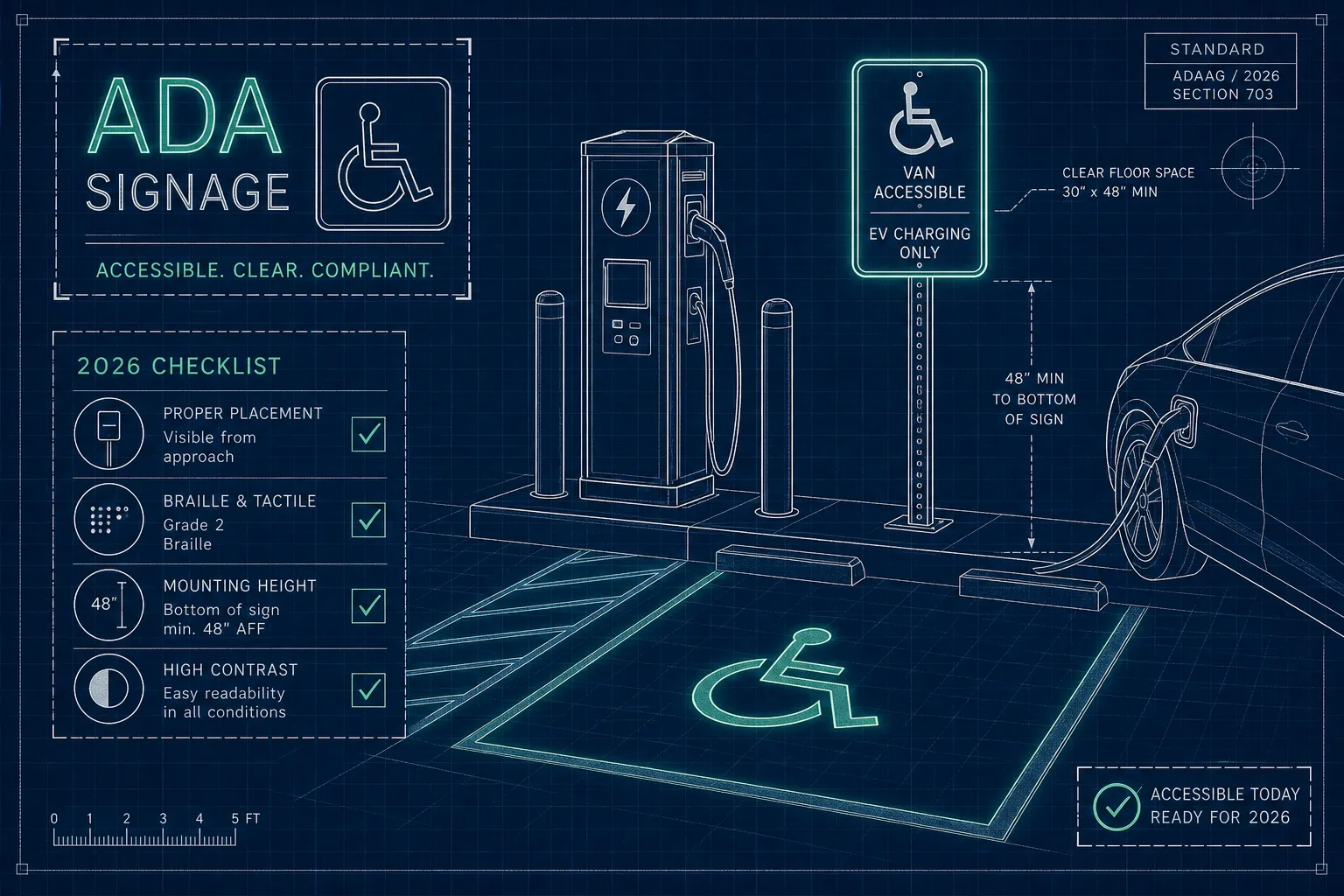
Many EV charging site operators assume that once the charger is installed and the stall is painted, they're done. They're usually wrong. ADA signage at every EV station operates under a layered system where federal guidance, state building codes, and local amendments each add their own requirements, and they don't always point in the same direction.
This article is a working checklist, not a legal overview. The framework here comes from coordinating ADA-compliant signage, pavement markings, and accessibility hardware across hundreds of EV charging sites nationwide. At Sterling EV, we manage all of those elements under one roof, and that operational experience shapes every item on this list.
Start with the federal baseline, then layer state and local requirements on top. That's the only sequence that gets you to a complete, defensible compliance picture.
What the Access Board currently requires for ADA signage at EV stations
The U.S. Access Board published proposed EV charging provisions as part of a September 2024 Notice of Proposed Rulemaking (NPRM). These provisions are not yet codified into the ADA Standards for Accessible Design as final rules, but they represent the current federal reference for accessible EV charging design. The Department of Justice must adopt them through its own separate rulemaking before they become binding ADA standards nationwide.
The ISA rule and when it actually applies
The proposed rule requires accessible EV charging spaces to be identified with a sign that includes the International Symbol of Accessibility (ISA), meeting ADAAG 703.7.2.1. Here's the counterintuitive part: the Access Board states that ISA signs are currently not recommended for accessible EV charging spaces unless a state or local code specifically requires them. If your site is in a jurisdiction that hasn't yet adopted EV-specific accessibility code amendments, you aren't automatically required to post ISA signs today under the federal baseline.
Mounting height: the one clear federal number
The proposed provision specifies that the bottom of the accessibility identification sign must be 60 inches minimum above the finished floor or ground surface. This matters because a sign mounted lower gets obscured by parked vehicles and fails a visual clearance audit immediately. This 60-inch specification applies to the accessibility identification sign only, general EV regulatory signs follow separate MUTCD mounting guidance.
What the federal baseline leaves open
The Access Board's current EV charging provisions don't prescribe a required sign face size, required wording legend, or finish standard for the accessibility sign. That's not an oversight; it's a gap that state codes fill. States like California, Colorado, and Washington have stepped in with substantially more detailed requirements than the federal proposal contains, making jurisdiction-by-jurisdiction review unavoidable.
How state and local codes raise the bar on ADA signage at EV stations
If your site is in a state with its own EV-specific accessibility requirements, those rules are what's actually enforceable on your project. The federal baseline is the floor. State and local codes are often the ceiling you'll be measured against during an inspection or a permit review.
California's CBC Chapter 11B: the most detailed state framework
California doesn't rely on the federal ADA Standards for EV-specific signage. Instead, CBC Chapter 11B, specifically Sections 11B-812.8 and 11B-812.9, governs accessible EV charging station identification signs and surface markings independently. California also requires that EV charging station signs comply with Caltrans Traffic Operations Policy Directive 13-01 (or its current successor) for wayfinding and regulatory signage. Identification signs must be reflectorized and at least 70 square inches in face area, requirements you won't find in the federal proposal.
How space count changes your signage requirements
California's threshold model, applied through local amendments like those in LA County, determines when ISA signage is required based on total EV charging space count. For 1 to 4 EV spaces, no ISA identification signs are required for accessible spaces. For 5 to 25 spaces, one van-accessible EVCS must carry ISA signage, while standard accessible spaces don't require it. For 26 or more spaces, all required accessible EVCS must be identified with ISA signage.
This threshold structure means a site can go from no ISA sign requirements to full ISA identification requirements simply by adding chargers in a later phase. Operators planning multi-phase buildouts need to model their signage requirements at every phase endpoint, not just at opening day.
Why you must check local amendments before ordering anything
Local jurisdictions can adopt amendments that go beyond state code on sign placement, wording, mounting height ranges, and van-accessible language. If your site is NEVI-funded, that adds another layer: NEVI signage requirements, including MUTCD-compliant directional signage and accessibility marking standards per 23 CFR Part 680 and FHWA guidance, apply on top of state and local rules and should be treated as a separate checklist item.
Pavement markings for EV stalls: what's required and what's recommended
Pavement markings are the ground-level half of your accessibility compliance picture. A compliant EV charging station needs more than a painted stall outline; it needs markings that actively communicate access rules to drivers, tenants, and enforcement officers.
Access aisle dimensions and marking requirements
The Access Board requires access aisles to be at least 60 inches wide, running the full length of the EV charging space, and adjacent to an accessible route. Two adjacent spaces may share a single aisle. The aisle must be marked to discourage parking in it, and hatch markings combined with "NO PARKING" text visible from the vehicular approach are the standard method. California code makes this requirement more explicit than the federal proposal, and it's the practical minimum you should apply regardless of jurisdiction.
The aisle can be on either the driver's side or the passenger's side, but once the site is built, the charger's reach range and cord length must correspond to the aisle's placement. Getting this wrong at the design stage means rework that's expensive to fix after concrete is poured.
EV stall pavement text, symbols, and color
Compliant stalls typically carry "EV CHARGING ONLY" or "NO PARKING EXCEPT ELECTRIC VEHICLES" in pavement text, paired with the EV charging symbol equivalent to MUTCD D9-11b. For accessible stalls, accessibility striping and aisle boundary markings reinforce the space's protected status. California guidance recommends 4- to 6-inch-wide green outlines for EV stalls, making them visually distinct from standard ADA-accessible parking spaces. Green markings aren't a federal requirement, but California and some other states have adopted them as standard practice for EV-only spaces; they're worth including wherever your site supports it.
ADA signage EV station specifications for outdoor charging environments
Once you know which signs you need, the next question is what those signs must be made of, how big they need to be, and how they should be mounted. Underspecifying the material or mounting at the wrong height means replacing signs or re-auditing the site sooner than you planned.
Sign sizes by location and context
Size selection follows the function and approach speed of each sign location:
- 12" x 18": Standard size for the main regulatory sign at a conventional parking facility stall.
- 12" x 12": The EV charging symbol plaque, typically mounted above or alongside the regulatory sign.
- 18" x 24": Appropriate when the sign must carry additional text, such as hours-of-use restrictions or tow-away language.
- 24" x 24" and 30" x 30": Wayfinding signs visible from road approaches, sized per MUTCD tables based on posted speed.
The most commonly missed item in this category is the EV symbol plaque, sites frequently install the regulatory sign without the companion 12" x 12" symbol, which creates a gap in both enforcement clarity and ADA identification.
Material, reflectivity, and mounting hardware
The sign face should be outdoor-rated aluminum or an equivalent corrosion-resistant metal substrate rated for permanent exterior traffic-sign use. Retroreflective sheeting is required so the sign is visible at night and under headlights. ASTM D4956 Type III prismatic sheeting is the practical baseline per MUTCD/FHWA retroreflectivity guidance; Type IV or diamond-grade sheeting is appropriate for high-humidity, coastal, or high-wear environments. Printed indoor-panel materials don't meet the durability or retroreflectivity standards for outdoor EV charging signage, the product spec sheet won't save you when a state inspector checks the material grade.
Mount signs on metal posts with tamper-resistant fasteners, especially at urban and high-traffic locations where sign theft is common. For MUTCD-style regulatory signs at parking facilities, the bottom of the sign should clear approximately 7 feet above grade to remain visible and avoid vehicle interference. In areas where post strikes are likely, a sleeved post set in concrete makes replacement after impact straightforward without requiring new concrete work each time.
The most overlooked mounting issue in this category is retroreflectivity grade: signs arrive on-site with a spec sheet listing the sheeting type, but no one verifies it matches what was ordered until a night-audit or formal inspection.
Your 2026 ADA EV charging signage compliance checklist
Print this section and take it to your next site walk. Each item maps to a specific requirement from the federal, state, or practical durability standards covered above.
Step 1: Know your jurisdiction before anything else
Confirm whether your state has adopted CBC Chapter 11B equivalents or its own EV-specific accessibility code amendments. Then check for local amendments from your city or county that override or extend state minimums. If your site is NEVI-funded, pull the NEVI signage compliance requirements as a completely separate checklist and work through them independently.
Step 2: Audit your accessible stall count and van-accessible designation
Count the total number of EV charging spaces on-site, including any that are currently permitted but not yet installed. Apply the applicable threshold rule from your jurisdiction to determine how many accessible EVCS are required and which must be van-accessible. Verify that required van-accessible spaces are correctly identified and that every access aisle meets the 60-inch minimum width with clear hatch markings.
Step 3: Check every ADA signage EV station item against specifications
Work through each of the following as a yes/no audit at each stall and each sign location:
- ISA sign present where your jurisdiction's threshold requires it
- Sign bottom mounted at 60 inches minimum above grade (Access Board proposed provision for accessibility identification signs)
- Sign face meets minimum area requirement (70 sq. in. in California; verify your jurisdiction)
- Retroreflective sheeting is ASTM D4956 Type III or higher
- Tamper-resistant mounting hardware on post
- Access aisle hatch markings and "NO PARKING" text present and visible from approach
- EV-only pavement text and EV symbol within or adjacent to each stall
- Green pavement outlines present where required or recommended by state code
- Van-accessible language on sign where required by space count threshold
The most commonly missed item in field audits is the access aisle hatch marking, particularly at sites where line striping was done by a general paving contractor unfamiliar with EV-specific accessibility requirements.
Step 4: Decide whether to self-source or use a coordinated partner
Ordering signs and markings piecemeal from multiple vendors regularly creates the same gaps in practice: mismatched retroreflectivity grades, inconsistent mounting heights, pavement paint that doesn't meet state spec, and no single point of accountability when something needs correction before the permit closes. For a single site, that's a manageable headache. For a network rollout across dozens of locations, multiply that by fifty sites and you're managing a spreadsheet of exceptions instead of a replicable process.
Sterling EV's turnkey model is built specifically for network operators and property owners who need consistent ADA signage across every EV station in their portfolio. Sterling coordinates ADA-compliant signage, wayfinding, accessible stall markings, pavement work, and installation under one project manager, from site survey through field commissioning. Every location gets the same specifications, the same materials, and the same installation process, which means your compliance audit looks the same at site one as it does at site fifty.
The compliance risk doesn't go away on its own
Getting ADA signage right at an EV station isn't a one-size checklist situation. The federal Access Board framework is still evolving. State codes like California's CBC Chapter 11B are already specific and enforceable. Local amendments add another layer on top of that.
The physical specifications for sign size, material, retroreflectivity, and mounting hardware are separate from the legal requirements that trigger them, and both sets have to be right simultaneously. Sites built before 2024, or those without jurisdiction-specific review, frequently carry at least one gap based on the pattern we see across network audits. The threshold rules around space counts make this more dynamic than a static compliance checkbox: add chargers in a future phase and your ADA signage EV station requirements can change overnight. Re-auditing at every phase boundary is the only way to stay current.
If you're building new EV charging sites or auditing an existing network, Sterling EV delivers ADA compliance, NEVI-compliant signage, accessible stall markings, wayfinding, and compliant hardware as a single coordinated package, one project manager, one set of specifications, and a consistent result at every location. Reach out to talk through what your site or network needs.